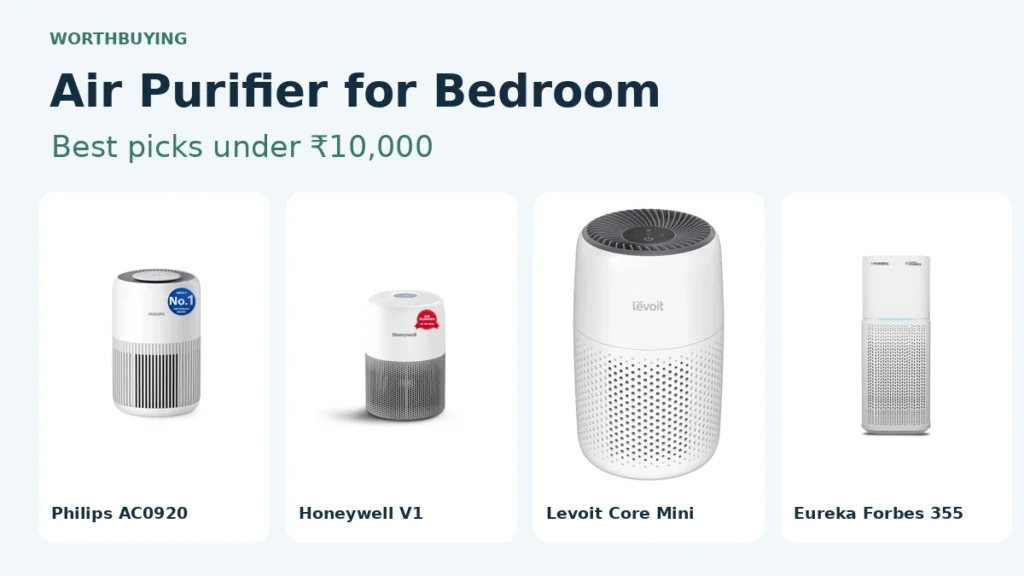
For an air purifier for bedroom use under ₹10,000, my top pick is the Philips AC0920 at ₹9,499. Above all, it lists 250 m³/h CADR, a compact 2.5kg body, a 20.5 dB minimum noise level and an AeraSense air-quality display.
However, before comparing discounts, measure your room, check how much clean air the machine delivers, and find out what its next filter costs. For example, a quiet-looking bedside machine and a purifier advertised for 750sqft may do very different jobs. So if your budget is tighter, the Honeywell Air Touch V1 costs ₹4,999.
Top pick at a glance: Philips AC0920, overall and quiet shortlist
₹9,499 (MRP ₹9,995) · 4.3/5 from 699 ratings · 250 m³/h CADR · 20.5 dB minimum · Pre-filter + NanoProtect HEPA · 21W maximum · two-year warranty.
Jump to: Table · Picks · Verdict · Buyer guide · Filter costs · FAQ · How I chose · How to choose · When I checked · Affiliate disclosure
Air purifier for bedroom: 7 picks compared
First, with sizing and running costs in mind, use these picks to narrow your search. For example, Philips balances airflow and controls; Honeywell lowers the entry cost; Eureka provides more stated airflow. Levoit is compact but needs particular caution on capacity. Note that these are checked prices, not permanent offers, and every model has a caveat.
| Pick (best for) | Amazon price | CADR |
|---|---|---|
| Philips AC0920 Overall / quiet shortlist | ₹9,499 | 250 m³/h |
| Honeywell Air Touch V1 Budget | ₹4,999 | 152 m³/h |
| Levoit Core Mini Compact bedside | ₹4,799 | India CADR unresolved |
| DREO HAP006 Sensor, conditional | ₹5,999 | 173 m³/h |
| Qubo Q200 App control | ₹7,490 | 150 m³/h |
| Sharp FP-J30M-BK Conditional shortlist | ₹8,430 | 180 maximum* |
| Eureka Forbes 355 Higher airflow | ₹9,999 | 355 m³/h |
Read my Amazon deal checklist before paying. *Sharp labels its figure “Air Flow/CADR”; see the model caveat below.
Best air purifier for bedroom under ₹10,000: my 7 picks
Now compare the actual models against your measurements, rather than choosing by brand alone. In addition, each profile keeps the checked Amazon price and rating alongside the relevant compromises. Brand sources fill important specification gaps, but regional variants and conflicting warranty terms still require confirmation.
1. Philips AC0920 — overall pick
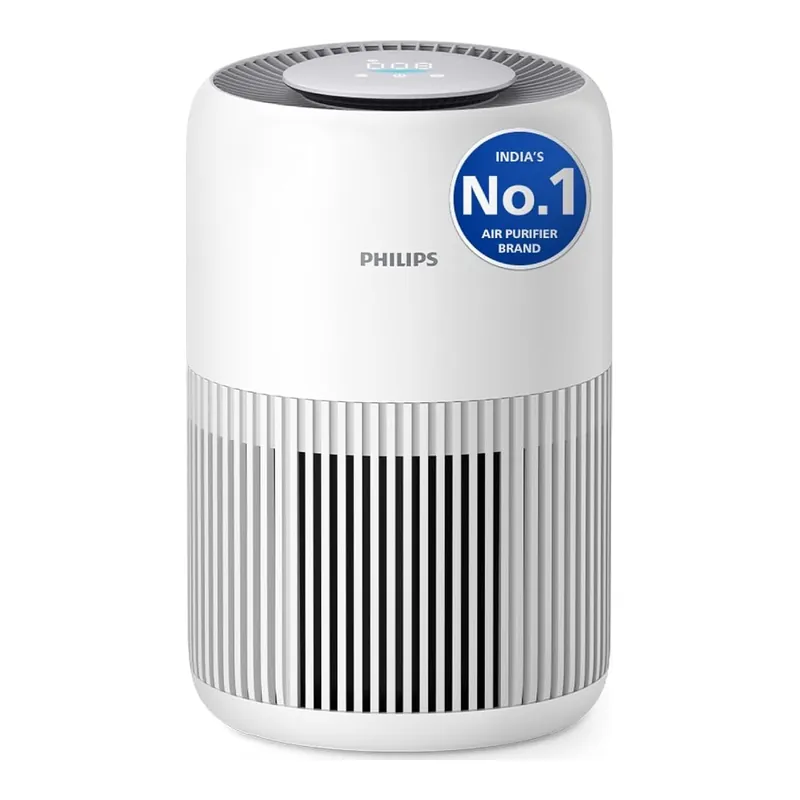
Price: ₹9,499 · MRP: ₹9,995 · Rating: 4.3/5; 699 ratings.
Overall, 250 CADR, a compact 2.5kg body and an AeraSense air-quality display make this the most balanced starting point. Its 21W maximum power and two-year warranty are useful extras.
CADR: 250 m³/h · Coverage: 300 sq ft title; 320 GB/T / 700 NRCC · Noise: 20.5 dB minimum · Filter: Pre-filter + NanoProtect HEPA.
Pros
- Above all, it has a good listed CADR of 250 m³/h.
- It also has a low 20.5 dB minimum noise level.
- In addition, it has on-device controls and an AeraSense display, so you need no app.
- Finally, its 21W maximum power and two-year warranty are useful extras.
Cons
- However, no carbon is identified in this model’s two-layer specification.
- Also, replacement-filter availability needs confirmation.
- The 20.5dB figure is at the lowest setting, rather than at full CADR.
Useful for: A small bedroom where you want a sensor without depending on an app.
Who should buy: most small bedrooms where you want strong listed airflow and a sensor without an app.
Skip if: you need carbon for odours, or your budget is closer to ₹5,000.
Verdict: My overall choice on listed specifications, not a hands-on winner. The 20.5dB figure is at the lowest setting, not proof of 250 CADR while sleeping.
2. Honeywell Air Touch V1 — budget pick
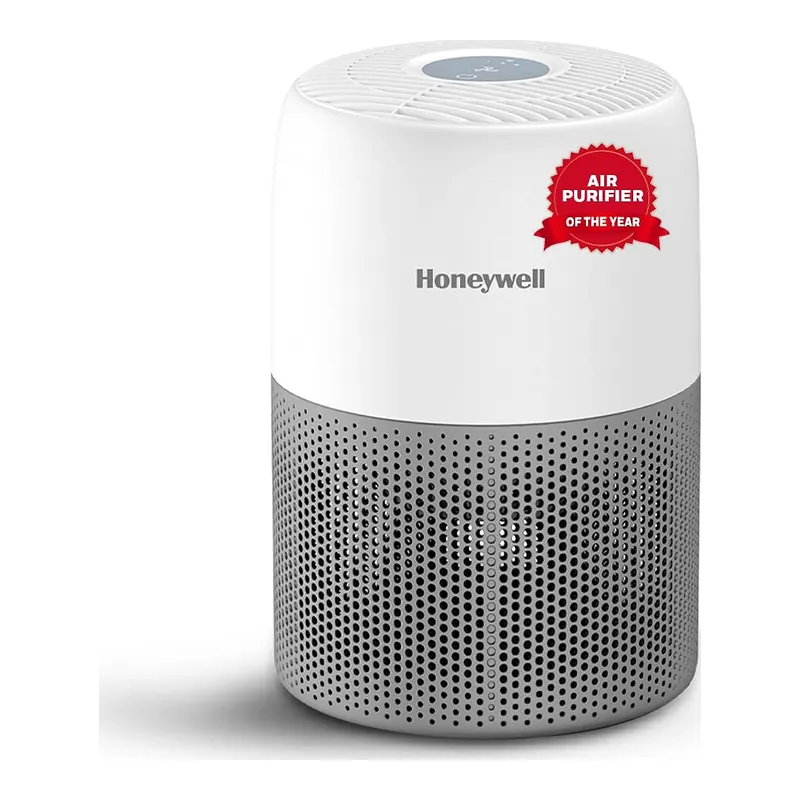
Price: ₹4,999 · MRP: ₹9,999 · Rating: 4.0/5; 11,952 ratings.
In short, you get a stated CADR and three-stage filtration below ₹5,000. Honeywell’s specification also adds 12W, 100–240V and up to 9,000 hours/one-year filter life. Moreover, the V1 weighs 1.5kg and carries a two-year manufacturer warranty. However, do not assume features from the more expensive V2 apply here.
CADR: 152 m³/h · Coverage: 235 sq ft; listing says 2 ACH · Noise: 29 dB listed · Filter: Pre-filter + H13 HEPA + carbon.
Pros
- Above all, it has a low entry price of ₹4,999.
- It also has a stated CADR of 152 m³/h.
- In addition, it has H13 HEPA and carbon filters, plus 11,952 ratings.
Cons
- However, it has manual three-speed controls.
- There is also no promised sensor or app.
- Moreover, owner feedback includes reliability complaints.
- Finally, its 152 CADR falls below my 120sqft, five-change example.
Useful for: A tight budget and a genuinely small, enclosed room.
Who should buy: buyers on a tight budget with a small, enclosed room.
Skip if: your room is larger than about 100sqft, or you want auto mode.
Verdict: A sensible budget shortlist, provided you confirm filter supply. Its 152 CADR falls below my 120sqft, five-change example; the headline coverage is not a guarantee of fast cleaning.
3. Levoit Core Mini — compact bedside option
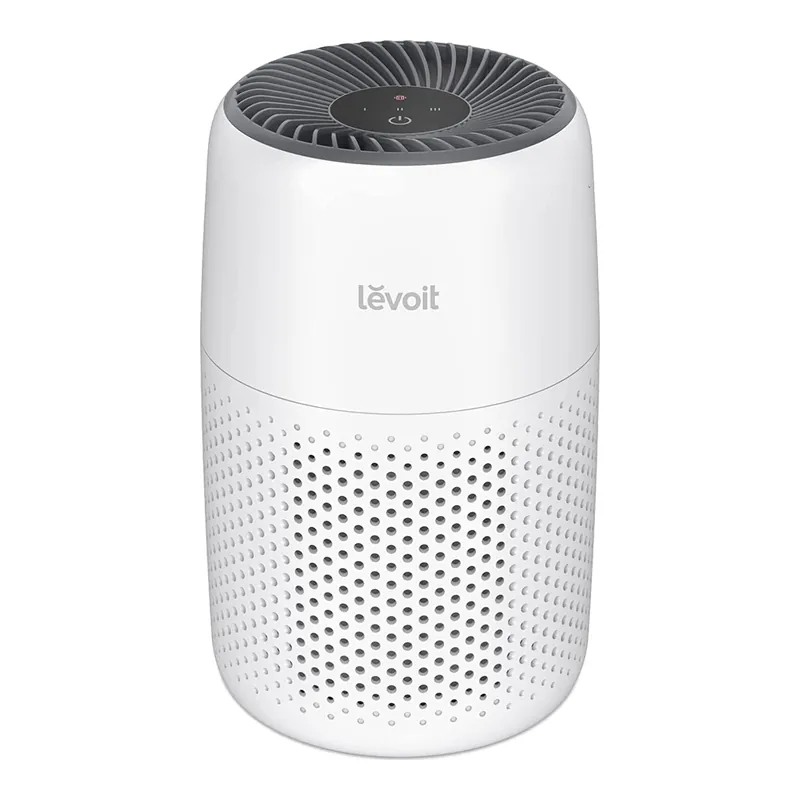
Price: ₹4,799 · MRP: ₹8,000 · Rating: 4.4/5; 5,132 ratings.
Above all, at 16.4 × 16.4 × 26.4cm and 1.06kg, this is the easiest model here to fit into a cramped corner. Also, listed power is 7W, with a two-year warranty and manual fan settings.
CADR: India-model figure unresolved; US Mini-P rated 34CFM (≈58m³/h) · Coverage: 183 sq ft description; conflicting 370 sq ft table · Noise: 25 dB minimum · Filter: Pre-filter + H13 HEPA + carbon, per listing.
Pros
- Above all, it has a small footprint, at 16.4 × 16.4 × 26.4cm and 1.06kg.
- It also has the lowest checked price here, ₹4,799.
- In addition, it has a low 25 dB minimum noise level and the best rating here (4.4 from 5,132 ratings).
Cons
- However, the India CADR figure is unresolved.
- Its coverage claims also contradict each other (183 sq ft vs 370 sq ft).
- Moreover, it has manual controls, without a promised sensor or app.
Useful for: A compact bedside air purifier shortlist, with enough clearance around it.
Who should buy: people with a cramped bedside corner and a very small room.
Skip if: you need proven capacity for a 250sqft room.
Verdict: Choose it for size, not a proven large-room capability. The US Mini-P page gives 34CFM and 25–44dB, but this does not establish the India unit’s CADR. Its official US manual uses a different filtration description from the India H13 claim; confirm the supplied filter. In short, treat it as a very-small-room machine, not a 250sqft choice.
4. DREO HAP006 — sensor option with caveats
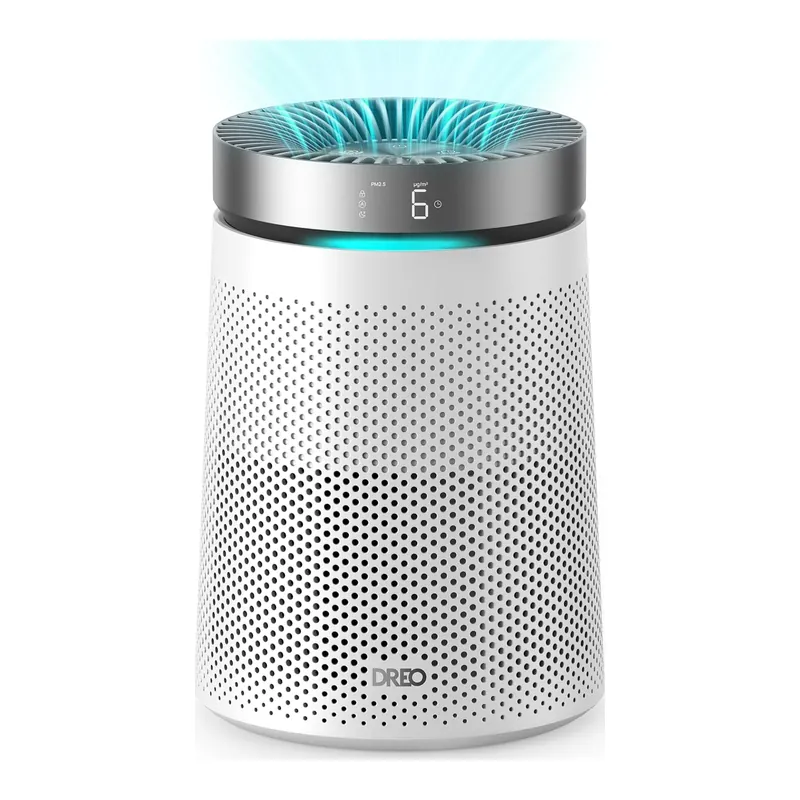
Price: ₹5,999 · MRP: ₹14,999 · Rating: 4.1/5; 424 ratings.
In particular, a PM2.5 sensor, LED display and auto mode stand out at this price. Also, the display is dimmable, and the listing includes a child lock and filter reminder. However, app control is not established for this India model.
CADR: 173 m³/h · Coverage: 14.7 m² at 4.8 ACH; 750 sq ft at 1 ACH · Noise: 25 dB sleep · Filter: Net pre-filter + True HEPA + carbon.
Pros
- Above all, it has a stated CADR of 173 m³/h.
- It also has a PM2.5 sensor and auto mode.
- In addition, the display is dimmable, with a child lock and filter reminder.
Cons
- However, Indian voltage remains unconfirmed.
- Also, the replacement filter is expensive (₹3,999 at an earlier Amazon check).
- Its 750 sq ft claim assumes only one air change per hour.
Useful for: Buyers willing to confirm voltage and local service details before ordering.
Who should buy: buyers who can confirm voltage and local service before ordering.
Skip if: you cannot get a rating-label photo and a written local warranty route.
Verdict: Do not buy on the 750sqft claim alone. For example, overseas reviews mention 120V units; that does not establish the Indian unit voltage. So confirm Indian mains compatibility and the two-year warranty route; filters and physical damage are excluded.
5. Qubo Q200 — app-control pick
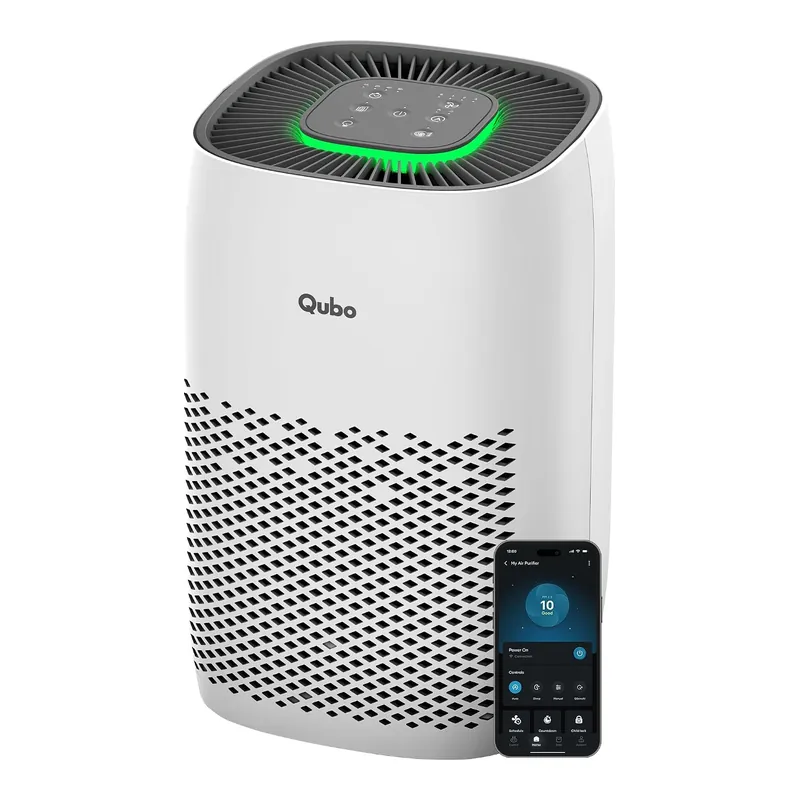
Price: ₹7,490 · MRP: ₹12,990 · Rating: 4.1/5; 1,405 ratings.
In particular, Qubo puts PM2.5 numbers in its app, alongside scheduling, auto mode and Alexa/Google support. That is convenient if you want to check the bedroom before bedtime. However, a numeric display on the purifier itself is not established.
CADR: 150 m³/h · Coverage: 200 sq ft claimed · Noise: 51dB(A) maximum per Qubo · Filter: Two pre-filters + nano-silver + carbon + H13.
Pros
- It has app scheduling, as well as sensor-driven auto mode.
- It also supports Alexa and Google voice control.
- In addition, the filter costs ₹1,590 on Qubo’s store.
Cons
- However, its CADR is modest, at 150 m³/h.
- It also has a 35W rated power.
- Besides, it carries only a one-year warranty.
Useful for: A small room where remote control matters more than maximum airflow.
Who should buy: people who want to check and schedule the bedroom from a phone.
Skip if: you want more airflow than the Honeywell V1, or a numeric display on the unit.
Verdict: An app-friendly option, not an airflow upgrade over Honeywell V1. Current bullets describe five stages, while older text says four layers. The Qubo specification table supplies 35W and 51dB(A) maximum; it does not establish sleep-speed CADR.
6. Sharp FP-J30M-BK — verify before buying
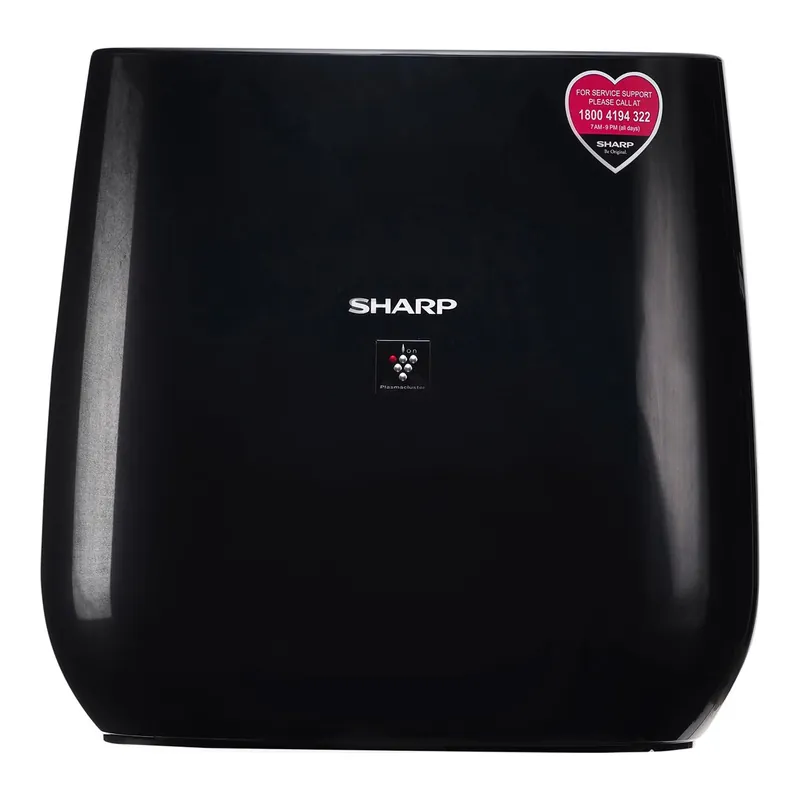
Price: ₹8,430 · MRP: ₹22,990 · Rating: 4.3/5; 163 ratings.
In addition, this 4.2kg model lists 50W power, a two-year comprehensive warranty and up to two-year HEPA/carbon filter life. Still, treat the filter-life figure as a claim, not a promise in your dust conditions.
CADR: Sharp’s combined Air Flow/CADR field gives 180/120/60m³/h · Coverage: 250 sq ft claimed · Noise: 44/36/23dB high/medium/low, per Sharp India · Filter: Pre-filter + HEPA + carbon; Plasmacluster ions.
Pros
- Above all, it has HEPA and carbon filters.
- It also lists a two-year warranty on Amazon.
- In addition, Sharp India lists 23dB in low mode.
Cons
- However, it uses combined airflow/CADR labelling.
- There are also contradictions on the sensor and warranty.
- Moreover, it is the heaviest compact pick here, at 4.2kg, with 50W power.
Useful for: Someone who specifically wants this Sharp model and can verify its controls.
Who should buy: people who specifically want this Sharp model and can verify its controls.
Skip if: you want clear, certified CADR or a confirmed sensor.
Verdict: A conditional shortlist rather than my first recommendation. Listing bullets claim a sensor and auto mode, but model-specific reviews disagree. The Sharp India sheet gives 50/30/13W, 23dB low mode and a one-year onsite warranty, versus Amazon’s two-year claim. So confirm written coverage. Its combined airflow/CADR field is not clear proof of independently certified CADR; do not assume an AQI display or app.
7. Eureka Forbes 355 — higher-CADR pick
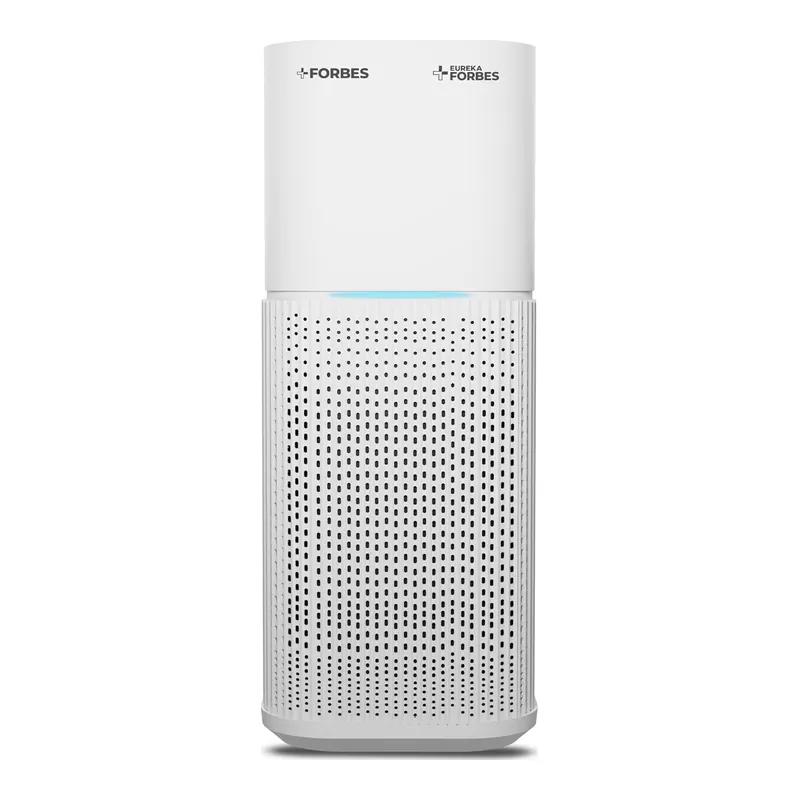
Price: ₹9,999 · MRP: ₹19,000 · Rating: 4.0/5; 172 ratings.
The strongest listed CADR here gives you more airflow headroom than the compact options. You also get a numeric PM2.5 display, colour indicator, auto mode and 12 fan settings. However, it weighs 5.42kg and stands 53.5cm tall.
CADR: 355 m³/h · Coverage: 480 sq ft claimed · Noise: 63dB per Croma; no sleep-speed figure · Filter: Pre-filter + carbon + H13 HEPA + plasma.
Pros
- Above all, it has the highest listed CADR here, 355 m³/h.
- It also has a numeric PM2.5 display and auto mode.
- In addition, it has 12 fan settings.
Cons
- However, it has a larger body, at 5.42kg and 53.5cm tall.
- Its published noise is also 63dB, with no sleep-speed figure.
- Besides, the replacement cartridge adds ₹2,499 a year.
Useful for: A larger bedroom where you can accommodate a taller purifier.
Who should buy: larger bedrooms where airflow matters most.
Skip if: you want a small, quiet bedside unit.
Verdict: The airflow-first choice under the checked budget, with a one-year warranty. Note that this is AP355, not the separate Smart AP355 variant. The Croma AP355 specification gives 35W and 63dB. Also, no sleep-speed CADR is established; do not transfer Wi-Fi features from the Smart variant.
Which air purifier for bedroom should you buy? My verdict
Philips is my balanced shortlist; Honeywell serves a tighter budget; Eureka adds listed airflow. Confirm room sizing, replacement supply and warranty before deciding. In the end, the best pick is the one you can afford to run at a useful speed.
Ready to shortlist? Recheck your selected variant and final price through its Check the product link above. Follow @worthbuyin on X for deal alerts.
Air purifier for bedroom buyer guide: what to consider first
Start with room volume and clean-air delivery, then check the filter, replacement supply, noise and electricity use. Sensors and apps come later. A small room air purifier should fit your space and maintenance budget, not merely carry the biggest coverage claim. Use the checklist below before comparing my seven picks.
What is CADR, in plain English?
CADR means Clean Air Delivery Rate: how much filtered air a machine supplies in a given time. Generally, higher numbers mean faster particle removal. AHAM explains CADR testing for smoke, dust and pollen. Check the units: 1 CFM ≈ 1.7m³/h, derived from cubic-foot-to-metre and minute-to-hour conversion. For example, a 100CFM rating is about 170m³/h, not 100m³/h.
How much CADR does your bedroom need?
For a 12 × 10ft room with a 10ft ceiling: volume = 1,200ft³ × 0.0283168 ≈ 34m³. At an illustrative five equivalent clean-air changes per hour, needed CADR = 34 × 5 ≈ 170m³/h. Still, this is a sizing example, not a health guarantee. Also, rated airflow is usually measured above sleep speed.
| Floor area | CADR target at 10ft ceiling / 5 changes |
|---|---|
| 100sqft | 142m³/h |
| 120sqft | 170m³/h |
| 150sqft | 213m³/h |
| 200sqft | 283m³/h |
| 250sqft | 354m³/h |
WorthBuy tip: Coverage claims do not compare directly. DREO’s 750sqft figure assumes one change per hour; Philips quotes different GB/T and NRCC areas. AHAM’s separate two-thirds sizing rule uses CFM, not m³/h. Check ceiling height and units before applying any shortcut.
HEPA, H13 or carbon: which filter matters?
HEPA targets particles; H13 describes a filter efficiency class, not the entire machine’s cleaning speed. Meanwhile, carbon is for some gases and odours, with effectiveness depending on its quantity and design. The US EPA air-cleaner guide explains these different jobs. A room air purifier with HEPA filter still needs adequate CADR. So do not treat “HEPA-type”, H13 and branded filter names as interchangeable.
What about filter cost and replacement life?
Check the exact replacement part before buying. A cheap purifier can cost more over time if cartridges are expensive. My table below now includes official-store prices where available. In addition, pollution and use affect lifespan; long-hour claims are not guaranteed intervals. Follow the manual and indicator, and never wash a HEPA cartridge unless explicitly permitted.
How do noise, sensors and AQI displays affect your choice?
Compare noise at the fan speed you will actually use. For example, a 20.5dB minimum does not prove full-CADR cleaning at that volume. PM2.5 displays report particles, not every pollutant; an “AQI” label is not independent calibration. Auto mode is convenient, but a particle sensor cannot tell you everything about smells or gases.
Should you avoid ionizers, and what does power cost?
The EPA cautions about ozone-producing air cleaners. Do not assume plasma or ion technology is harmless from marketing alone; ask about emissions testing and whether it can be disabled. As for power, watts ÷ 1,000 × hours gives kWh. Philips at 21W for eight hours daily uses about 5.04kWh/month: roughly ₹40 at an assumed ₹8/unit, excluding filters and tariff charges.
What will replacement filters cost each year?
Official stores provide several usable prices, but availability and replacement intervals vary. The annual figures below assume one cartridge per year solely for budgeting; they are not guaranteed service intervals. Levoit’s manual suggests more frequent changes, and Sharp’s two-year claim may last less in dusty conditions. Confirm compatibility before ordering.
| Model / replacement | Source price and availability | Illustrative annual cost |
|---|---|---|
| Philips FY0900/30 | Philips filter finder: ₹2,370; listed, stock confirmation needed | ₹2,370 at one/year |
| Honeywell V1 compound | Honeywell: ₹1,549; brand collection marks sold out | ₹1,549 at one/year; wait for supply |
| Levoit Core Mini replacement | Official overseas filter exists; no dependable India OEM rupee quote found | Get India quote; US manual says 4–6 months |
| DREO HAP006 filter / B0GCN5Q2SQ | Earlier Amazon check: ₹3,999; refresh before buying | ₹3,999 at one/year; not a lifespan promise |
| Qubo HPH01 | Qubo filter collection: ₹1,590; offered in collection | ₹1,590 at one/year |
| Sharp FZ-F30HFE / FZ-F30DFE | Sharp HEPA store: ₹3,869, in stock; carbon price unresolved | ₹3,869 HEPA-only at one/year; carbon extra |
| Eureka GAPMF400Z10749 | Eureka integrated filter: ₹2,499; PIN-dependent fulfilment | ₹2,499 at one/year |
Sharp’s purifier page names those replacement parts, but its filter-store compatibility list differs: confirm FP-J30M-BK fit with support. Meanwhile, Philips and Qubo claim up to 9,000 hours; actual conditions can shorten that. For DREO, neither an India-specific voltage document nor a fresh filter quote was established: ask for a rating-label photo and written local warranty route before purchase.
Air purifier for bedroom: FAQ
The right setup matters as much as the shortlist. Give the purifier unobstructed airflow, use a sensible fan speed and maintain its filters. Above all, keep expectations realistic: a purifier is not ventilation or a medical treatment. These answers apply generally; your selected model’s safety and clearance instructions always take priority.
Should I keep the purifier on all night?
Yes, if the manufacturer permits continuous use and you follow safety instructions. Sleep mode trades airflow for quiet; use a stronger setting before bedtime if appropriate, then choose an overnight speed that suits your room.
Is a ₹5,000 purifier enough for a bedroom?
Possibly for a small room. However, Honeywell’s 152m³/h falls below the 170 target in my example. A low price does not establish capacity; neither does a large advertised coverage figure.
Where should you place it?
Keep intake and outlet clear, away from curtains and enclosed shelves, following manual clearances. A bedside air purifier still needs space. AHAM recommends unobstructed positioning rather than a blocked corner.
How often should you change the filter?
Follow the manual, condition and reminder. The Levoit US Core Mini manual suggests 4–6 months and pre-filter cleaning every 2–4 weeks. So do not apply one model’s schedule to every purifier.
Does an air filter for bedroom use replace ventilation?
No. It recirculates indoor air rather than supplying fresh outdoor air. Therefore, manage pollutant sources and ventilation separately. A PM2.5 display cannot tell you the full indoor-air picture.
How I chose these air purifiers
How I picked these
I started with bedroom air purifiers under ₹10,000 on Amazon.in, then checked each listing against official brand pages, manuals and filter stores. Then I filtered hard, so only seven made the cut.
- Specs that hold up: I compared CADR, coverage, noise and filters from the listing and the brand source, and I flag every conflict under each pick.
- Ratings: the picks range from 4.0 to 4.4 stars, and the Honeywell V1 alone has 11,952 ratings.
- Running cost: I looked up the replacement filter for each model, from ₹1,549 to ₹3,999 a year at one cartridge.
- One per job: an overall pick, a budget pick, a compact bedside unit, a sensor option, an app pick, a conditional Sharp and a higher-airflow pick.
Brand sources fill important specification gaps, but regional variants and conflicting warranty terms still need confirmation. However, I have not measured noise or airflow myself.
These are research-based picks from listings, specs, price history and buyer reviews, not hands-on tests.
How to choose an air purifier for bedroom use
Use this checklist before you pay. It uses only the facts in this guide, rather than a lab test.
- First, measure your room in order to work out the CADR you need. For example, a 12 × 10ft room needs about 170m³/h at five changes an hour.
- Next, check the units, because 1 CFM is about 1.7m³/h.
- Then pick the filter: HEPA for particles, and carbon for some gases and odours.
- After that, price the replacement filter, since a cheap purifier can cost more over time.
- Also, compare noise at the fan speed you will actually use, not just the minimum figure.
- Finally, avoid ozone-producing ionizers unless you can confirm emissions testing, and work out power cost with watts ÷ 1,000 × hours.
When I checked
I checked these prices on Amazon.in on 7 November 2026, the day this guide went live. Prices and stock can change, and delivery depends on your PIN code, so confirm the live price before you pay.
Affiliate disclosure
As an Amazon Associate, WorthBuying earns from qualifying purchases. Also, these are research-based picks, and I take no paid placements.
